How to Plan an Antarctica Trip: Costs, Best Time to Visit, Cruises & Expedition Tours
Disclosure: WingReserve may earn a commission if you book through certain links in this guide, at no additional cost to you. This does not influence the information we provide. We have not made this trip ourselves. Everything below comes from the operators and organisations listed in the sources, checked in November 2026.
Picture the last evening in Ushuaia. The town sits at the bottom of Argentina, with mountains behind it and the Beagle Channel in front, and the last light turns the water the colour of slate. Down at the pier, an expedition ship is loading. Passengers walk up the gangway in ordinary travel clothes, still carrying the question that dominated months of planning: will it be worth it?
Antarctica is not like other international trips. There is no commercial airline you can simply book, no hotel strip, and no independent way in for most travellers. Almost everyone arrives on an organised expedition, which means the planning is the trip's first big decision. Which route, which season, which ship, and how much of the budget goes where.
This guide is built to help you make those decisions. It covers whether Antarctica is worth it, the real cost, the best time to go, how you get there, what an expedition cruise involves, what to pack, and how to compare trips. It is written for first-timers, and it will tell you plainly where the trip is a poor fit.
The short answer
- Season: tourist voyages run from about late October to March.
- Most common trip: a 10 to 13 day ship voyage from Ushuaia, Argentina, crossing the Drake Passage (about 48 hours each way).
- Budget: published lead fares for 2027–28 start around US$10,500, plus roughly US$1,500 to US$4,000 for flights, insurance, gear and extras. Our cost breakdown has the full numbers.
- Insurance: compulsory, with medical evacuation cover of at least US$100,000 and often more.
- Booking window: plan roughly a year ahead for the best choice of dates and cabins.
Is an Antarctica Trip Worth It?
For many travellers who go, the answer is yes, and for a simple reason: very few places are left that still feel genuinely wild. There are no cities, no hotels and no roads between destinations. Penguins and seals go about their business a few metres from where you stand.
But "worth it" depends on who you are and what you expect. Antarctica rewards people who are happy with an unpredictable schedule, who enjoy being outdoors in cold weather, and who see the journey, including two days crossing the Drake Passage each way, as part of the story. It is a poor fit for people who need a fixed itinerary, who want hotel-style comfort at a budget price, or who would be stressed by spending a large share of their travel savings on one trip.
The honest summary: it is one of the most memorable trips available, and one of the least forgiving of poor planning. The rest of this guide is about the planning.

How Much Does an Antarctica Trip Cost?
Short version: the cruise fare is the biggest number, but not the only one. We cover it in detail in our separate guide, How Much Does a Trip to Antarctica Cost in 2027–28?, so here is the framework.
- The advertised fare. Published "from" prices for 2027–28 classic Antarctic Peninsula voyages from Ushuaia start at roughly US$10,500 and rise steeply for luxury ships, the Antarctic Circle, and trips that add South Georgia.
- What the fare usually excludes. International and domestic flights, hotel nights, insurance, tips, kayaking, camping and gear. One 2026 price survey puts these extras at roughly US$1,500 to US$4,000 per person.
- Why fares differ. Cabin category, length, departure date, ship, and route. A fly-cruise costs more per night than a sailing, and December and January are priced above March.
- Solo travellers. Single supplements range from nothing to about 75 percent of the twin fare, depending on the operator.
As a planning rule, treat the advertised fare as the lower part of your budget, not the whole of it. Our cost guide includes a worked example.
Best Time to Visit Antarctica
The expedition season runs from about late October to March. No tourist ships operate between April and October, when the sea freezes and the polar night sets in. Within the season, there is no single best month. The right month depends on what matters to you.
| If you most want... | Consider | Why |
|---|---|---|
| Fresh snow and courting penguins | November | Mating season for seals, penguins and seabirds. Icebergs are at their sharpest and pack ice may be walkable. |
| Long daylight and the Antarctic Circle | December to January | Penguins are nesting, warmer temperatures open more landing points, and near the Circle the sun barely sets. January is the warmest and most popular month. |
| Whales and penguin chicks | February | Whales arrive in krill-rich waters, and penguin chicks are active and learning to swim. |
| Lower fares and dramatic light | March | Whales are feeding before migrating, days are shorter, and low-season cabin prices can be better. It is also colder. |
Source: Intrepid Travel, "When is the best time to visit Antarctica?" (November 2026).
The trade-offs are real. Early-season trips have more ice and snow but fewer chicks. Late-season trips have whales but colder weather. If you can only go once and flexibility is limited, February and the shoulder weeks either side of it are a sensible compromise, though no month guarantees any particular sighting.
How to Get to Antarctica

Most Antarctica trips follow the same pattern.
- Fly to Argentina. Most travellers connect through Buenos Aires. A 2026 price survey puts return flights from the US to Buenos Aires at roughly US$530 to US$1,200, depending on city and season. You can compare flights before you commit to dates.
- Fly on to Ushuaia. The same survey puts a return Buenos Aires to Ushuaia flight at roughly US$108 to US$272. Some operators include a charter flight, so check before booking your own.
- Spend a night in Ushuaia. Arriving the day before embarkation is the safe choice. Some operators include a hotel night and transfers. Others do not, so you may need to book a hotel yourself.
- Board the ship and cross the Drake Passage. The crossing takes about 48 hours, and the passage is just under 1,000 kilometres wide.
Other departure points exist. Some voyages sail from Puerto Williams in Chile, and fly-cruises depart from Punta Arenas in Chile. Whichever you pick, leave a buffer at the end: one operator advises not booking a flight home that departs before noon on the day you return to port, in case weather causes a delay.
What Is an Antarctica Expedition Cruise?

An expedition cruise is a different animal from a conventional cruise. The ship is smaller, the schedule is flexible, and the point is to get you off the ship and into the landscape.
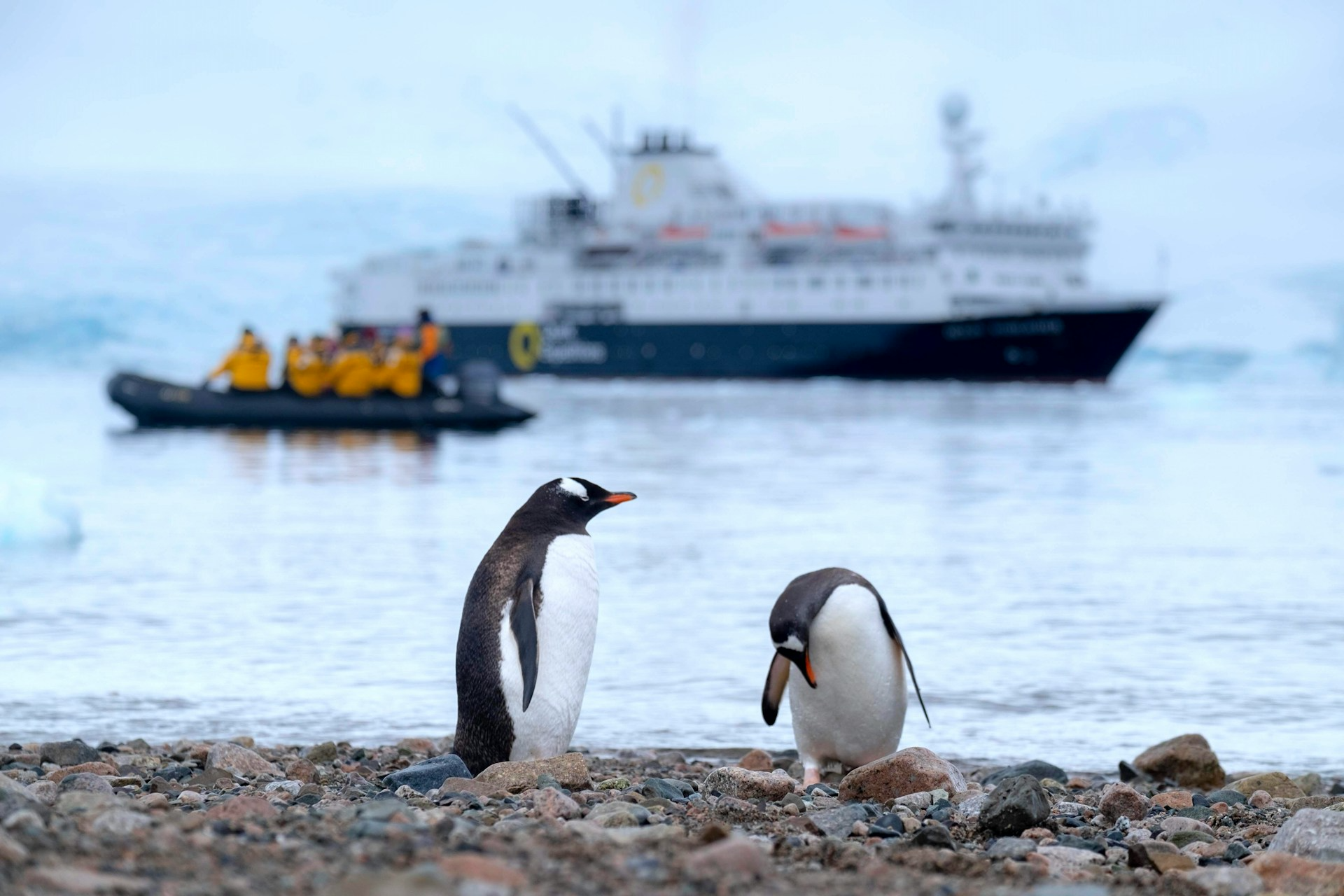
On a typical day, as operators describe it, you are briefed the evening before about the next day's plan. Mornings may include a talk by a specialist, followed by a shore landing or a Zodiac cruise, which is an outing in a sturdy inflatable boat that reaches shores a ship cannot. After a break for lunch, there may be a second landing or Zodiac outing. Onboard lectures cover subjects such as wildlife, polar history, geology and ocean science.
Weather and ice decide everything. The captain and expedition team choose landing sites on the day, and plans change. That flexibility is part of what you are paying for, and it is why itineraries are always described as a plan, not a promise.
Why ship size matters
Under Antarctic Treaty visitor guidelines, no more than 100 passengers from a vessel may be ashore at one time, there must be at least one guide for every 20 visitors, and ships carrying more than 500 passengers may not land anyone. On a ship of 100 passengers or fewer, everyone can go ashore together every time. On larger ships, landings run in shifts, so you get less time on land at each stop. Our cost guide explains how this affects value for money.
Antarctica Cruise vs Fly-Cruise: Which Is Better?
A fly-cruise replaces the Drake Passage crossing with a flight of about two hours from Punta Arenas, Chile. You then board the ship in Antarctic waters. A sailing from Ushuaia crosses the Drake by sea in both directions.
| Factor | Sail from Ushuaia | Fly-cruise |
|---|---|---|
| Drake Passage | About 48 hours each way. Swells typically 3 to 4 metres, up to 7 to 8 metres in very bad weather | Avoided on the flown leg |
| Cost | Lower fares, from about US$10,500 in 2027–28 | Published fares commonly start higher. One survey found roughly 30 to 100 percent more per night |
| Weather risk | Rough seas | Flight delays can postpone the start |
| Time | 10 to 13 days is typical | Shorter trips available, from 6 days on some programmes |
| Best for | Travellers who value price and the journey itself | Travellers short on time or worried about rough seas |
Sources: Intrepid Travel (Drake Passage), Antarctica21 (flight and trip lengths), Small Ship Travel (price comparison, July 2026).
Neither option is better for everyone. If you have a week of leave, flying is the practical choice. If you have time and a tighter budget, sailing is the better value. If a delay would wreck your plans, build in a spare day either way.
How Long Should an Antarctica Trip Be?
Length changes what you see more than most people expect. Each day in the itinerary is not a day in Antarctica. On a sailing from Ushuaia, about four days go on the Drake Passage crossings, so a 10-day trip leaves roughly four to five days among the Peninsula's landing sites. That is our own arithmetic from the itinerary, not an operator figure, but it explains why trips of 11 to 13 days are the most common.
| Length | Example voyage | Operator's advertised "from" fare and date | What it adds |
|---|---|---|---|
| 10 days | Antarctic Peninsula: The Pure Expedition | US$11,095, departing 4 February 2027 | The essentials of the Peninsula in the shortest sailing format |
| 11 days | Antarctic Peninsula: An Explorer's Expedition | US$10,580, departing 13 December 2027 | An extra day or so for landings |
| 12 days | Antarctic Peninsula: The Classic Voyage | US$10,536, departing 21 March 2028 | The most common classic length |
| 14 days | Extended Antarctic Circle Crossing | US$13,395, departing 1 December 2027 | A chance to cross 66°33'S, ice permitting |
| 21 days | Extended Falklands, South Georgia and Antarctica | US$19,625, departing 28 October 2027 | Falklands and South Georgia as well as the Peninsula |
Source: Intrepid Travel, Antarctica trips from Ushuaia 2027/2028 (checked November 2026). Fares are the lowest-priced departure listed for each voyage, per person, and change often.
Wildlife You May Encounter in Antarctica

The wildlife is the reason many people go, and it is also the part nobody can guarantee. Sightings depend on season, location and conditions on the day.
- Penguins. Gentoo, Adélie and chinstrap penguins nest on the Peninsula during the southern summer, with chicks active by February.
- Seals. Weddell seals, which keep breathing holes open in the ice with their teeth, are seen in January. Elephant seals moult on beaches in March.
- Whales. February is described as the best month for whales, including humpbacks, orcas, minkes and blue whales, in krill-rich waters.
- Seabirds. They join the seals and penguins in the breeding season, which starts in November.

The rules that protect wildlife
Antarctic Treaty visitor guidelines ask you to stay at least 5 metres from wildlife on land, and 15 to 25 metres from fur seals where practicable. Taking souvenirs of any kind is prohibited, including feathers, bones, eggs, rocks and fossils. Drones must not be used near wildlife. You will also be asked to clean boots, clothing, bags and tripods before landing, to avoid carrying in seeds, soil or disease. These rules shape how you behave on shore, and your guides will brief you on them.
What to Pack for an Antarctica Cruise
Some operators lend or supply the heaviest gear, so check before you buy. For example, Intrepid supplies an expedition parka and waterproof boots on loan, and an insulated inner jacket you keep. You give your sizes about four months before departure. Your operator's packing list takes priority over any general list, including this one.
Packing checklist
- Check first: whether your operator provides a parka and boots.
- Waterproof trousers (a typical personal purchase).
- Thermal base layers and mid-layers.
- Warm hats and waterproof gloves, plus a spare pair.
- Sunglasses and sunscreen. The light off snow and water is strong.
- Personal medication, with extra supply and a doctor's letter if you have health needs. One operator recommends at least two extra weeks of medication.
- Camera, spare batteries, and protection from spray.
- Passport, insurance documents and booking confirmations.
- Waterproof bag for camera gear on Zodiac rides.
If you have to buy gear, one 2026 estimate puts personal expedition gear at roughly US$600 to US$1,000. For data on your way through Argentina, our eSIM comparison is useful. Connectivity at sea is limited, so do not rely on it.
Important Things to Know Before You Go
- Remote means remote. Polar regions are hard to reach in a medical emergency, which is why operators will not let you board without evacuation cover.
- Insurance is compulsory. Minimum evacuation cover varies by operator: Oceanwide Expeditions requires US$100,000 per person for the Peninsula, Intrepid requires US$250,000 including ship-to-shore transfer, and industry ranges run up to US$500,000. Check that adventure options such as kayaking or camping are covered if you plan to do them. Our travel insurance comparison explains what to look for.
- Physical requirements. One operator rates its Antarctica cruises 2 on a physical scale and says there is no formal fitness requirement, but you need to be in good health, climb steep narrow stairs, step into a Zodiac with crew help, and complete safety drills unaided. Landings can involve shallow water or rocky, uneven ground.
- Weather changes plans. Landings can be cancelled and routes changed at short notice.
- Booking and cancellation. Deposits are commonly 10 to 25 percent of the fare, or a flat amount per person. Policies differ. As one example, Lindblad Expeditions' published policy charges no penalty 120 or more days before departure (with the payment held as a travel credit), 50 percent from 119 to 90 days, and 100 percent from 89 days. Read your operator's terms before you pay.
Antarctica's visitor numbers are also in the news. According to figures cited from the International Association of Antarctica Tour Operators (IAATO), the 2025–26 season recorded about 85,200 landed visits and 27,200 cruise-only visitors. At the 2026 Antarctic Treaty meeting in Hiroshima, governments discussed how to regulate and monitor tourism but adopted no new binding limits. For travellers, the current landing rules still apply.
How to Choose the Right Antarctica Expedition
When you compare trips, a lower headline price can hide a worse experience. Use this checklist to compare like with like.
- Route and length. Peninsula only, Antarctic Circle, or South Georgia and the Falklands too?
- Ship size. How many passengers? Can everyone land at once? This matters more than cabin decor.
- Season and date. Does the month match what you want to see?
- Cabin and single supplement. What is the lowest cabin on the advertised fare, and what does solo travel cost?
- What is included. Pre-voyage hotel night, transfers, charter flight, kayaking, camping, parka and boots, tips. Some luxury lines include hotel and transfers. Others do not.
- Insurance requirement. What is the minimum evacuation cover?
- Cancellation terms. How much do you lose, and when?
- Total cost. Fare plus flights, hotels, gear, insurance, tips and extras.
Ready to compare real departures? See Antarctica expeditions by length, route, ship and month, then read the full itinerary before you decide.
Where to Find Antarctica Expedition Tours
TourRadar is an online marketplace for organised multi-day trips. It does not run the expeditions itself. The tours listed are operated by tour companies, and you book through the platform. It is one convenient place to compare many operators in one list, and you should still read each operator's own terms and inclusions.
The table below lists examples of Antarctica tours shown on TourRadar in November 2026. We list names, operators and lengths only. Open each listing for current prices, dates, inclusions and traveller reviews, because those change often and vary by departure.
| Tour | Operator | Length | Starts in | Format | Listing |
|---|---|---|---|---|---|
| Classic Antarctica, M/V Ocean Victory | Explore! | 10 days | Ushuaia | Sea voyage | View itinerary → |
| Classic Antarctica, Douglas Mawson | Explore! | 12 days | Ushuaia | Sea voyage | View itinerary → |
| Classic Antarctica, 10 days | On The Go Tours | 10 days | Ushuaia | Sea voyage | View itinerary → |
| Celebrating New Year's in Antarctica | Intrepid Travel | 11 days | Ushuaia | Sea voyage | View itinerary → |
| Antarctic Express: Fly the Drake (operated by Quark) | Exodus Adventure Travels | 8 days | Punta Arenas | Fly-cruise | View itinerary → |
Listing details checked on TourRadar in November 2026. Availability and prices change, so confirm everything on the listing page.
Final Thoughts
Go back, for a moment, to that pier in Ushuaia. By the time the ship clears the Beagle Channel, the planning is over, and what is left is two days of open water and then the first iceberg. Whether that moment is worth the money depends on how well you prepared: a ship small enough to get you ashore, a season that matches what you hope to see, a budget that includes the extras, and insurance that actually covers you.
Take your time with the comparison. The best Antarctica trip is rarely the cheapest or the most expensive. It is the one whose route, ship and season match what you came for.
Narrowed it down? Compare Antarctica expeditions side by side and read each itinerary in full before you book.
Compare Antarctica trips →Before you book: full cost breakdown · travel insurance · flights
Frequently Asked Questions
How much does an Antarctica trip cost?
What is the cheapest way to visit Antarctica?
What is the best month to visit Antarctica?
How do you get to Antarctica?
How many days do you need for an Antarctica trip?
Is the Drake Passage dangerous?
Can you see penguins in Antarctica?
Do you need special clothing for an Antarctica cruise?
Is an Antarctica trip suitable for first-time expedition travellers?
Is travel insurance necessary for Antarctica?
Sources
Information checked in November 2026. Operators change itineraries and prices often, so confirm details on your booking.
- Intrepid Travel: Best time to visit Antarctica
- Intrepid Travel: How long does it take to cross the Drake Passage?
- Intrepid Travel: Fitness for Antarctica
- Intrepid Travel: Antarctic traveller information
- Intrepid Travel: Antarctica trips from Ushuaia 2027/2028
- Antarctica21: Itineraries
- Small Ship Travel: How much does an Antarctica cruise cost? (2027–28)
- Oceanwide Expeditions: Insurance requirements
- Antarctic Treaty: Visitor guidelines (Resolution 4, 2025)
- German Environment Agency: Tourists in Antarctica
- Wild Foot Travel: Life on board an Antarctic cruise ship
- Lindblad Expeditions: Cancellation policy
- ICAS: Antarctic tourism after ATCM 48 (IAATO 2025–26 figures)
- TourRadar: Antarctica tours (listing index, November 2026)
Related Posts
-
 Antarctica
How Much Does a Trip to Antarctica Cost?
Real 2027–28 fares and the extras nobody mentions.
Read more →
-
Insurance
Best Travel Insurance Companies Reviewed
Seven companies compared on what actually pays out.
Read more →
-
Group Tours
Intrepid Japan Express Review
Is the 9-day Tokyo to Osaka group tour worth it?
Read more →